The Architect — Patek Philippe Ref. 4183/1
The Architect: The Art of the 70s Never Looked So Sexy
The Art of the 70s Never Looked So Sexy.
The 1970s were a time of uncompromising creativity — a decade that broke the rules, redefined elegance, and celebrated individuality.
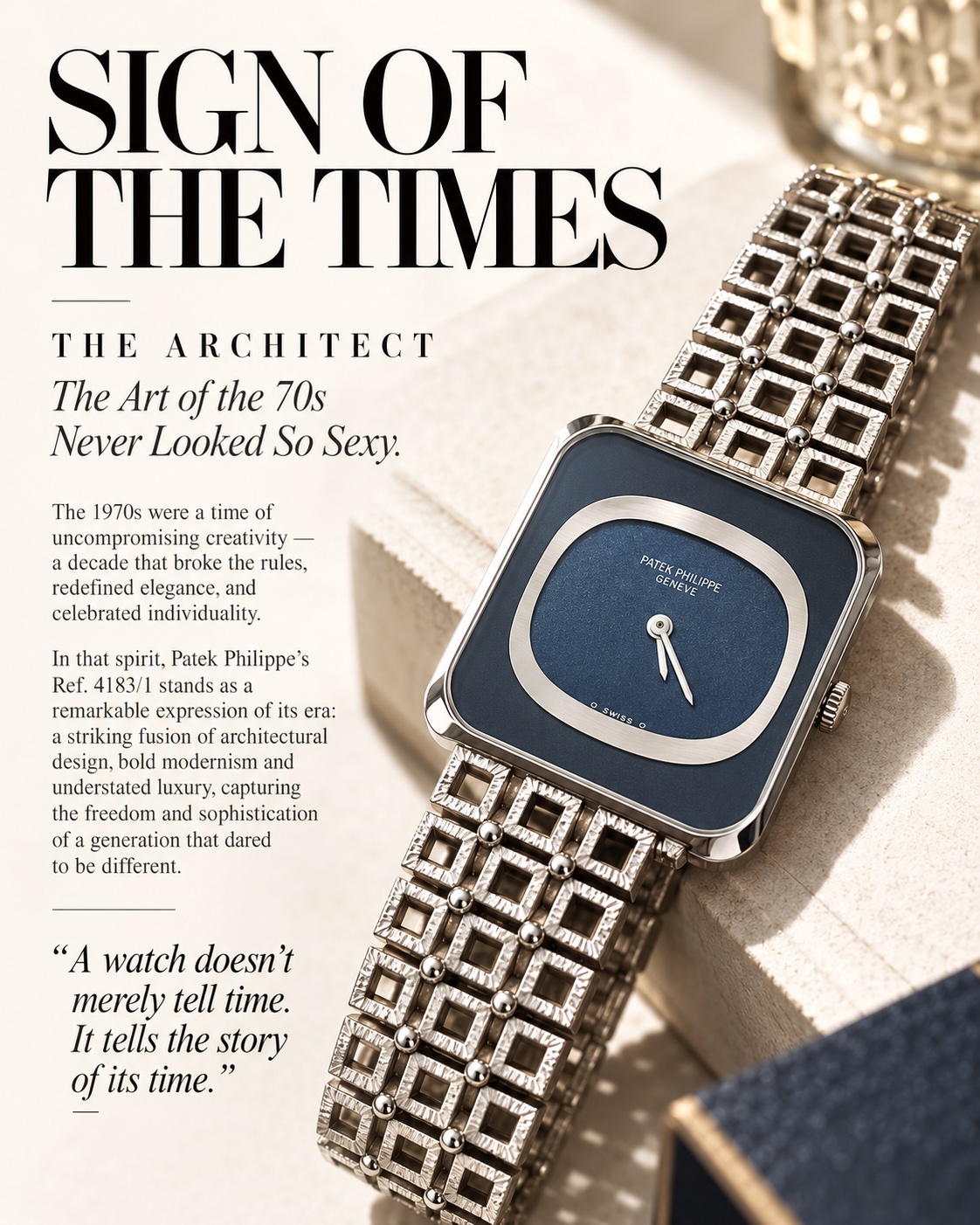
In that spirit, Patek Philippe’s Ref. 4183/1 stands as a remarkable expression of its era: a striking fusion of architectural design, bold modernism and understated luxury, capturing the freedom and sophistication of a generation that dared to be different.
“A watch doesn’t merely tell time. It tells the story of its time.”
Where Art Meets Architecture
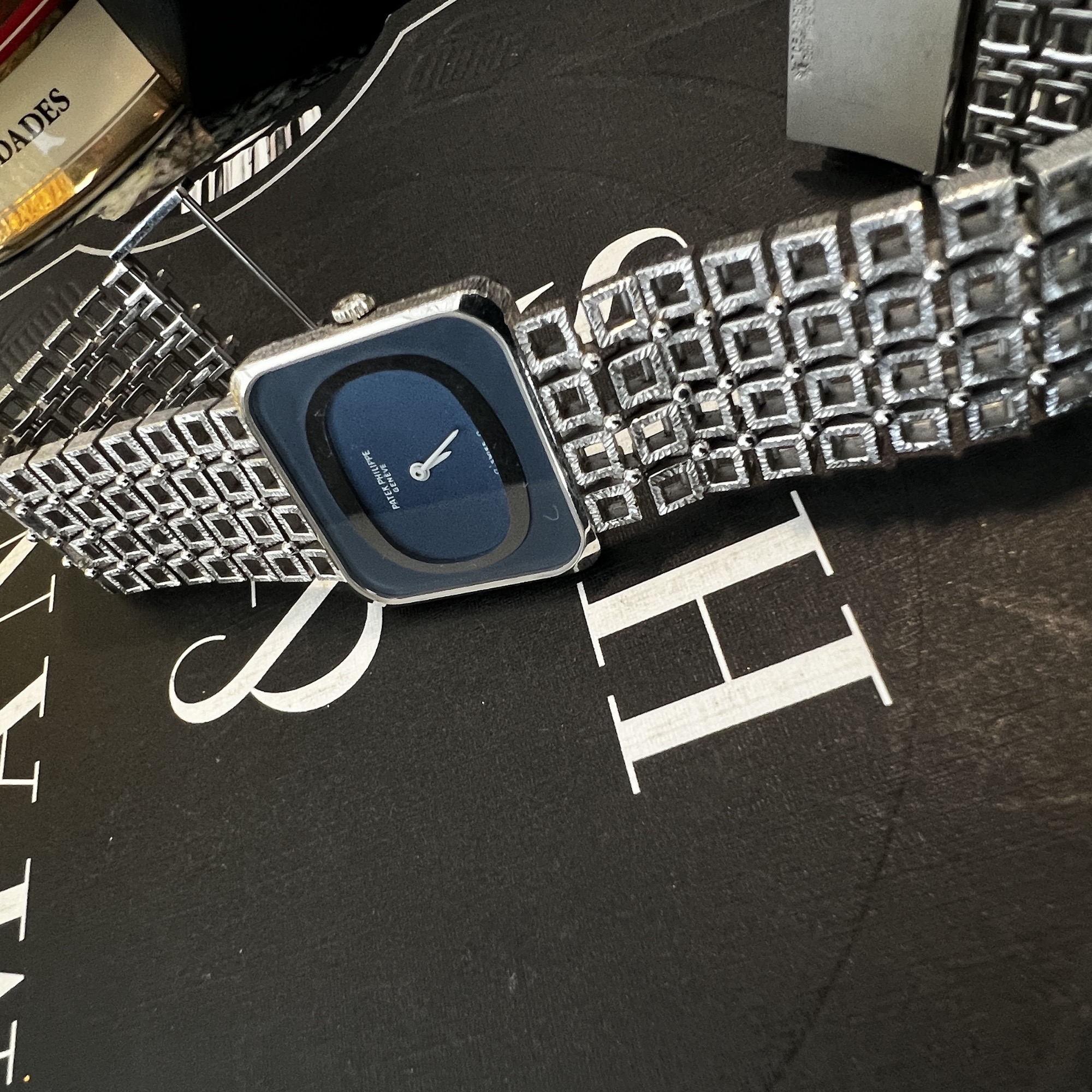
With its striking blue dial and extraordinary openworked bracelet, the 4183/1 is as much a piece of modernist sculpture as it is a masterpiece of watchmaking.
Its intricate succession of geometric squares creates a fascinating interplay of light, structure and empty space.
The dial is no less intriguing. Its distinctive construction brings together a deep-blue centre and a contrasting metallic surround, creating a play of colour, geometry and depth beneath the crystal.
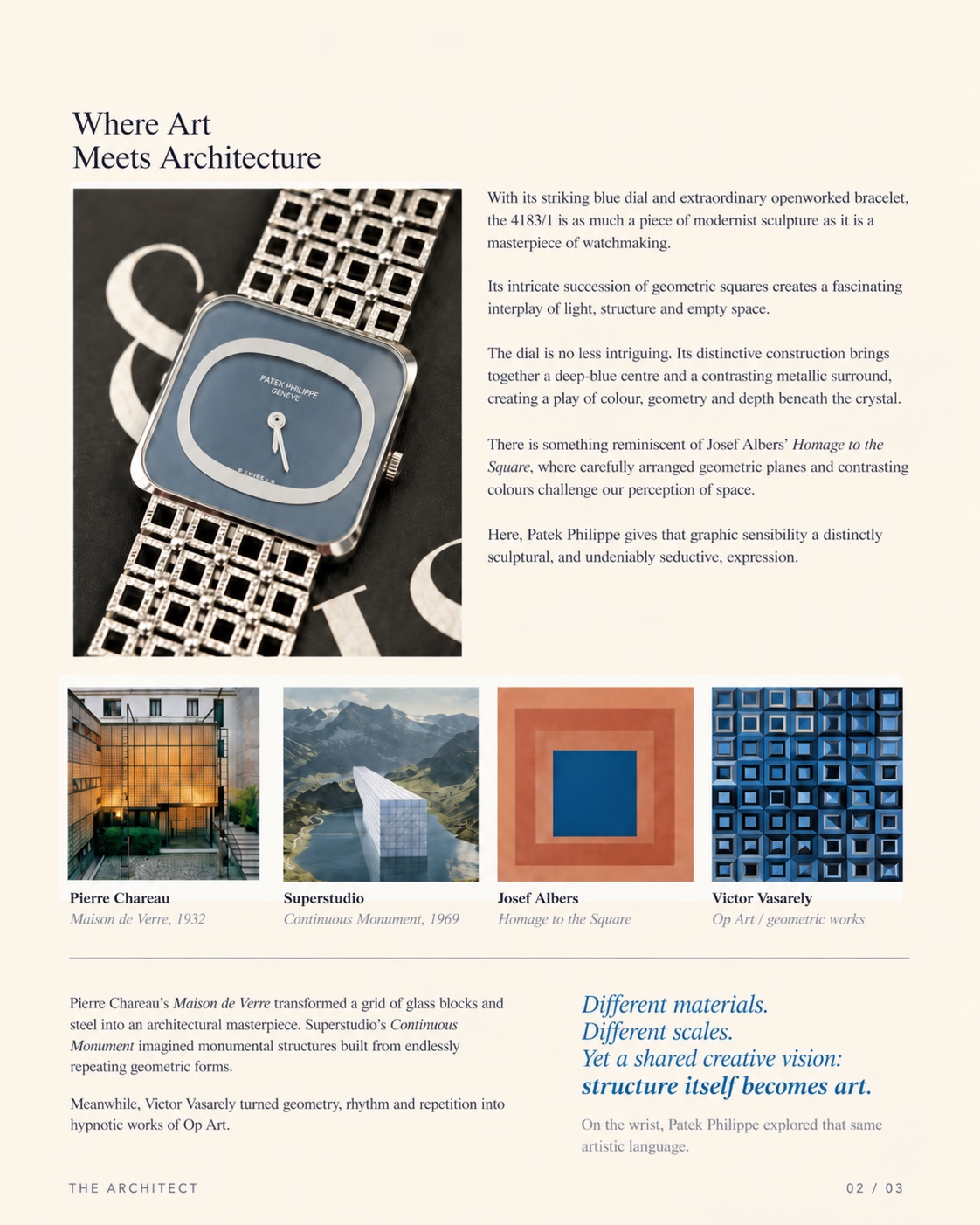
There is something reminiscent of Josef Albers’ Homage to the Square, where carefully arranged geometric planes and contrasting colours challenge our perception of space.
Here, Patek Philippe gives that graphic sensibility a distinctly sculptural, and undeniably seductive, expression.
Pierre Chareau’s Maison de Verre transformed a grid of glass blocks and steel into an architectural masterpiece. Superstudio’s Continuous Monument imagined monumental structures built from endlessly repeating geometric forms.
Meanwhile, Victor Vasarely turned geometry, rhythm and repetition into hypnotic works of Op Art.
Different materials. Different scales. Yet a shared creative vision: structure itself becomes art.
On the wrist, Patek Philippe explored that same artistic language.
The Human Hand: Where Vision Becomes Art
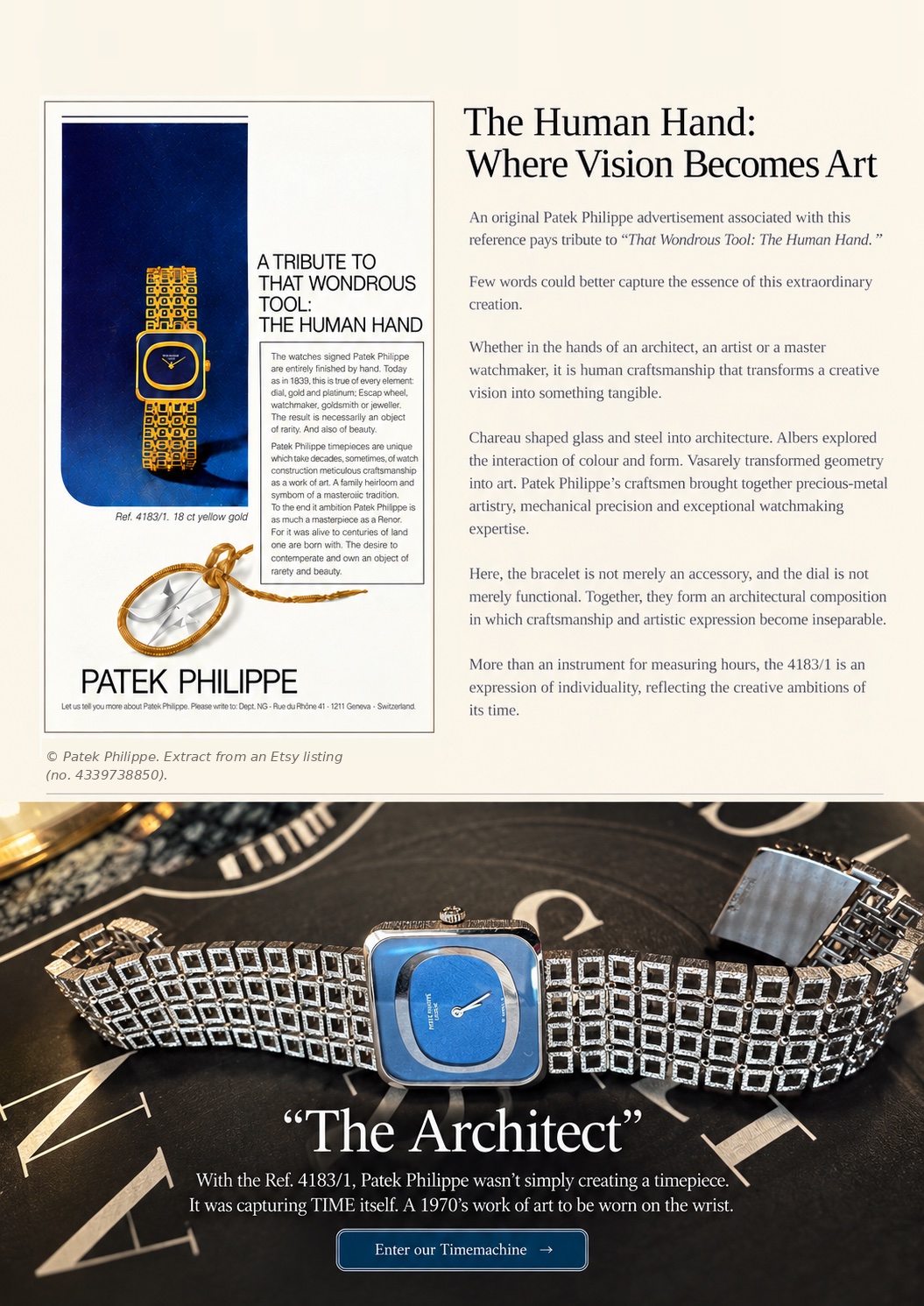
An original Patek Philippe advertisement associated with this reference pays tribute to “That Wondrous Tool: The Human Hand.”
Few words could better capture the essence of this extraordinary creation.
Whether in the hands of an architect, an artist or a master watchmaker, it is human craftsmanship that transforms a creative vision into something tangible.
Chareau shaped glass and steel into architecture. Albers explored the interaction of colour and form. Vasarely transformed geometry into art. Patek Philippe’s craftsmen brought together precious-metal artistry, mechanical precision and exceptional watchmaking expertise.
Here, the bracelet is not merely an accessory, and the dial is not merely functional. Together, they form an architectural composition in which craftsmanship and artistic expression become inseparable.
More than an instrument for measuring hours, the 4183/1 is an expression of individuality, reflecting the creative ambitions of its time.
“The Architect” — A 1970s Work of Art
With the Ref. 4183/1, Patek Philippe wasn’t simply creating a timepiece. It was capturing time itself. A 1970s work of art to be worn on the wrist.